
United States President Barack Obama secretly offered Pakistan in 2009 that he would nudge India towards negotiations on Kashmir in lieu of it ending support to terrorist groups like Lashkar-e-Tayiba and Taliban, but much to his disappointment Islamabad rejected the offer.
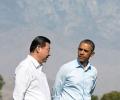
Spread over two days -- Friday and Saturday -- at a picturesque desert resort in Southern California, Obama, 51, and Xi, 59, had several rounds of meetings and a candle-lit dinner spread over nearly eight hours on a range of bilateral, regional and global issues.

Senior commanders of the two armies held intense negotiations for nearly 11 hours on Sunday at a designated meeting point in Moldo on the Chinese side of the Line of Actual Control.

Schumer and Menendez said the months-long demonstrations have been met with orders from the central government and local authorities to shut off internet access in protest areas, cut off water and electricity supplies for the tens of thousands living in protest camps, and impede the work of journalists reporting on the protests.

'All this talk of 'tactical nuclear weapons' or a limited nuclear war are 'false flags'! It looks like India and Pakistan are slowly but surely inching towards this realism,' says Colonel Anil A Athale (retd).
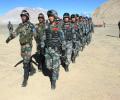
During the course of the intense and complex negotiations between senior commanders of the two armies that ended at 2 am on Wednesday, the Indian delegation also apprised the Chinese PLA about the "red lines" and conveyed that the onus was largely on China to improve the overall situation in the region, the sources said.

"Just a handful of Indian youth have joined the ISIS. Some have also returned after being persuaded by their families," asserted the home minister.

Aziz Haniffa/Rediff.com reports from Washington, DC, on what makes Prime Minister Narendra Modi and US President Barack Obama get along so well.

It will not be to India's advantage to create misperceptions that it is bandwagoning with some Anglo-American project for regime change in Myanmar, argues Ambassador M K Bhadrakumar.
'The Delhi-Washington stalemate can end only if India's concern over trans-border terrorism is addressed.' 'The Indian security establishment expects a spike in terrorist attacks in the months ahead.' 'And there is every likelihood that India may retaliate against Pakistan at some point,' observes Ambassador M K Bhadrakumar.

Rebuffed by the Obama administration on its effort to seek US intervention on Kashmir, Pakistan has said that it has never made such a "demand" and just presented its wish list to Americans on the issue.

'Everybody says 5G and communication is important.' 'Everybody says automation, robotics, human computing interfaces -- people and machines working together -- is the future.' 'Everybody agrees that cybersecurity is something that is here to stay.' 'Everybody agrees that synthetic biology is important.' 'Instead of outlining thinking about industries for tomorrow and the future, let the evolutionary pathway be built in a way that it promotes robust, creative, thinking.'

The Ministry of External Affairs (MEA) spokesperson Anurag Srivastava said complete disengagement requires re-deployment of troops by each side towards their regular posts on their respective sides of the Line of Actual Control(LAC) and this can be done only through mutually agreed actions.

He said both sides reaffirmed to sincerely work towards complete disengagement of the troops along the LAC.
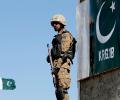
'If push comes to shove, Pakistan does have the capability to make it difficult for the US and NATO forces to make even a withdrawal of troops out of Afghanistan in orderly fashion,' says Ambassador M K Bhadrakumar.

American whistleblower Edward Snowden, currently sheltered in the transit zone of Moscow airport, has sought asylum in 20 countries, including India.
'Narendra Modi is a beginner on the national scene. Intelligence and security will be new for him on a national scale. He will succeed if he crosses the bureaucratic barriers. If he entangles himself in these barriers, then I highly doubt he will succeed,' former R&AW agent R K Yadav tells Rediff.com's Vicky Nanjappa.
'The real purpose of President Obama writing to President Zardari,' Husain Haqqani tells Rediff.com's Aziz Haniffa, 'was to seek a turnaround on terrorism -- that Pakistan, whatever its grievances, cannot have jihadi groups operating openly on its soil.'

Fourteen years ago on September 11, terrorists hijacked four passenger planes and targeted the United States, killing 3,000 people in the attacks.
'The world does not care about the tension on our border.' 'India has to emerge as a strong economic power.' 'Respect comes when the world sees a country with a direction and leadership that has a vision,' points out Ramesh Menon.

Prime Minister Narendra Modi's visit will highlight the growing collaboration between India and the US and their "shared leadership" on the world stage, the White House said on the eve of his arrival.

India must present its demands of America confidently, instead of fearing that its pocket will somehow be picked, says Ajai Shukla.

"Few nations are more vital to the future of American security and prosperity than India," Garcetti told the committee.

"This will be the first dinner for a foreign dignitary at the White House under this administration. So, we think that's very significant," a senior administration official told reporters at the White House on the eve of Modi's arrival.

>Putin's last-minute intervention with PM salvages $5.43 bn pact.

'If India is already involved in helping the insurgents in Baluchistan and Karachi, as Pakistan says, it is but one step for New Delhi to bring Dawood or Hafiz Saeed into its sights,' says Amulya Ganguli.

The Indian intelligence brass may have snared a key Pakistani spy and Jadhav's arrest is Pakistan's way of getting even with India, says Rajeev Sharma.

Friends of India in the US hope that New Delhi will receive a presidential waiver, given that Trump Administration has recognised India as a major defence partner and is in advance stage of selling billions of dollars' worth of equipment to India in the next few years.

Opposition to tri-service structures comes not just from bureaucrats and politicians as the generals like to lament, but equally from within the military. Neither the army, navy or air force chiefs want to relinquish control over their theatre commands, with these cutting edge units placed under some commander who reports elsewhere, says Ajai Shukla.

Putin is looking beyond the current regime in Kyiv. Of course, if the Western military assistance to Kyiv continues in any form, Washington knows that Russia will regard it as a hostile act and there will be severe consequences, predicts Ambassador M K Bhadrakumar.

'Indian diplomacy faltered amidst multiple failures of statecraft.' 'The functionaries responsible must be held to account for their abject failure,' asserts Ambassador M K Bhadrakumar.
Modi talking about Balochistan, PoK and Gilgit is a tectonic shift in India's policy towards Pakistan, says Abhay Jere.

IIM Lucknow has concluded its 2020-21 final placements.
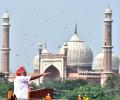
References to Balochistan, Gilgit and Pakistan-occupied Kashmir by Prime Minister Narendra Modi signals a change in India's Pakistan policy, top American experts on South Asia have said as they sought more clarity on New Delhi's new approach towards disturbed areas in Pakistan.

We present to you a blow-by-blow account on what happened on the night of May 1, 2011, when the terror mastermind was killed

Trump is accompanied by First Lady Melania, daughter Ivanka, son-in-law Jared Kushner and the top brass of his administration.
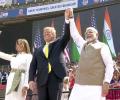
Trump's visit symbolised heightened partisanship and a return to chemistry between leaders defining bilateral ties, notes Kashish Parpiani.

Trump's foreign policy juggernaut has shelved the 'Deep State' and 'Axis of Evil'. But where is India?

'China knows the best way of twisting the knife in its dealings with India: By launching a major incursion into Indian territory,' says Rajeev Sharma.
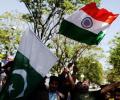
'The talks held in Bangkok, virtually on Indian terms, is an event where Pakistan seems to have blinked first.'
 © 2026 Rediff.com - Advertise with us - Disclaimer - Privacy Policy - Sitemap - Feedback - About us - Terms of use - Grievances